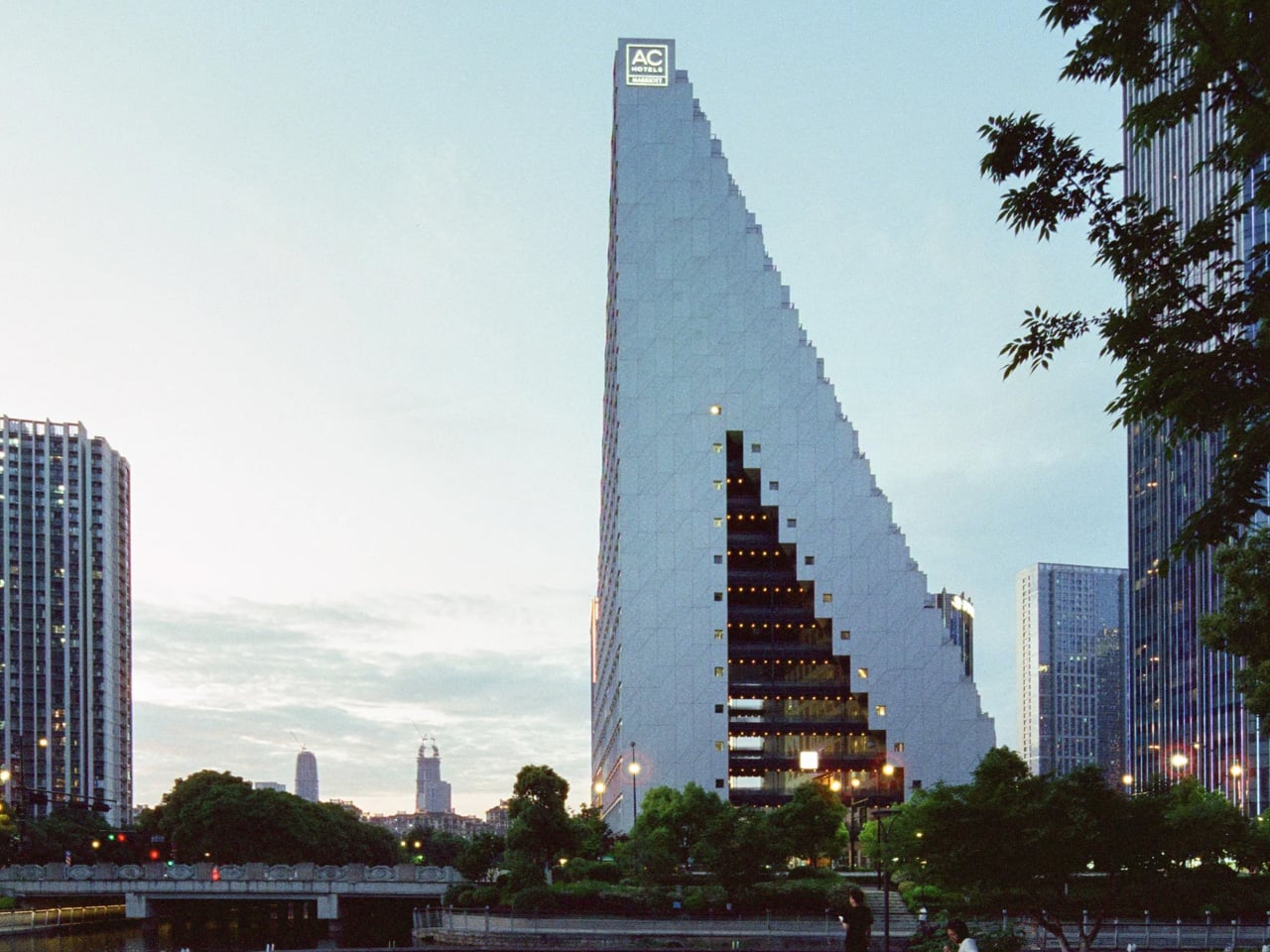
There’s a centuries-old Chinese proverb that goes: ‘above, there is heaven; below, there is Suzhou and Hangzhou.’ OMA’s newly completed Hangzhou Prism doesn’t just reference it — it builds toward it. Peaking at 106.5 metres in the heart of Hangzhou’s Future Tech City district, the Prism has arrived as one of China’s most formally daring mixed-use structures.
The project, led by OMA partner Chris van Duijn and project architect Michael Hadjistyllis, broke ground in 2019 and has been years in the making. Commissioned by Xinhu Real Estate Group, the 43,000-square-metre building departs entirely from the logic of the conventional tower. Rather than stacking a cluster of residential volumes in the usual fashion, OMA collapsed them into a single, porous structure — what van Duijn describes as a “three-dimensional village for young professionals and visitors.”
Designer: OMA
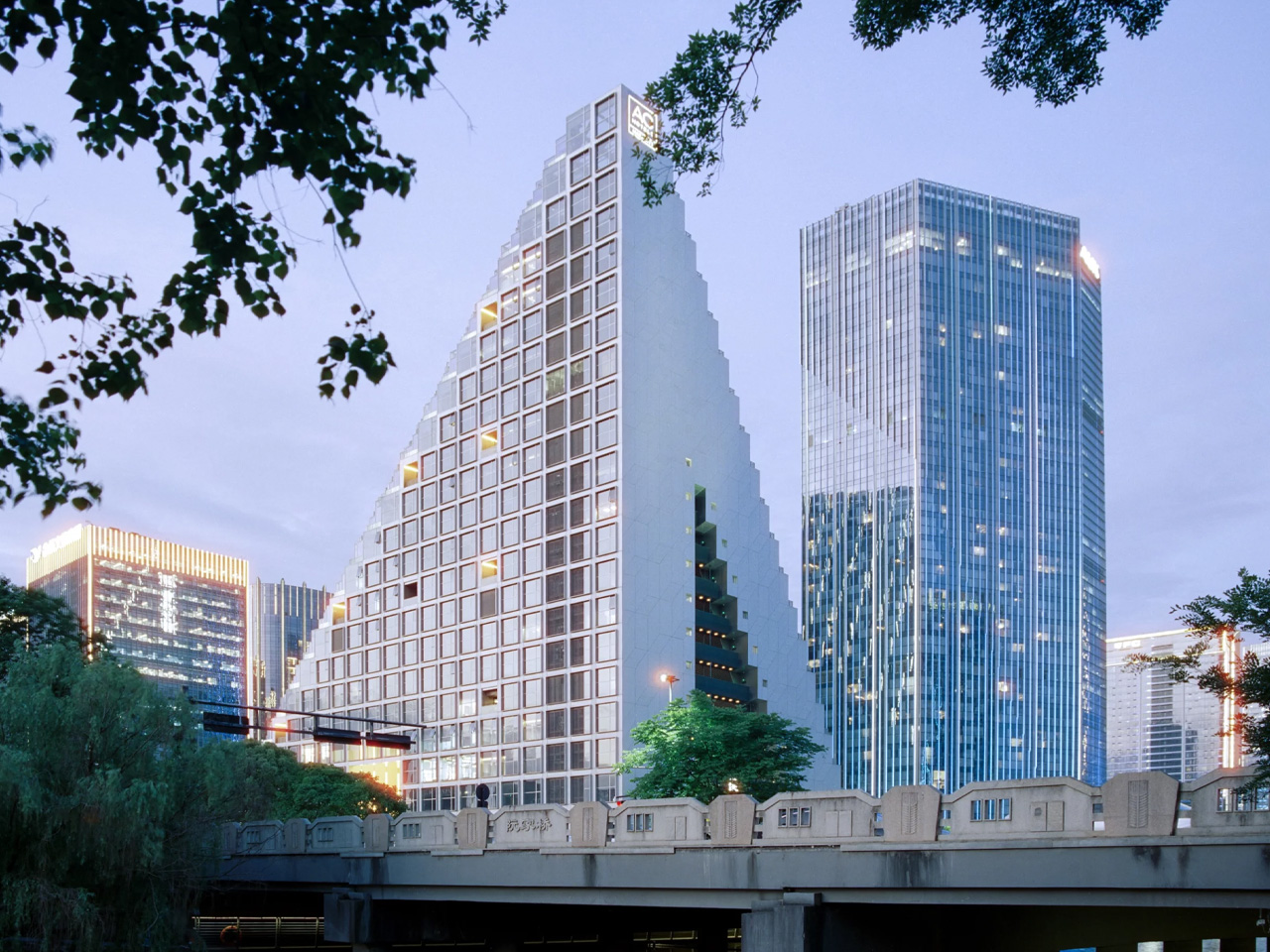
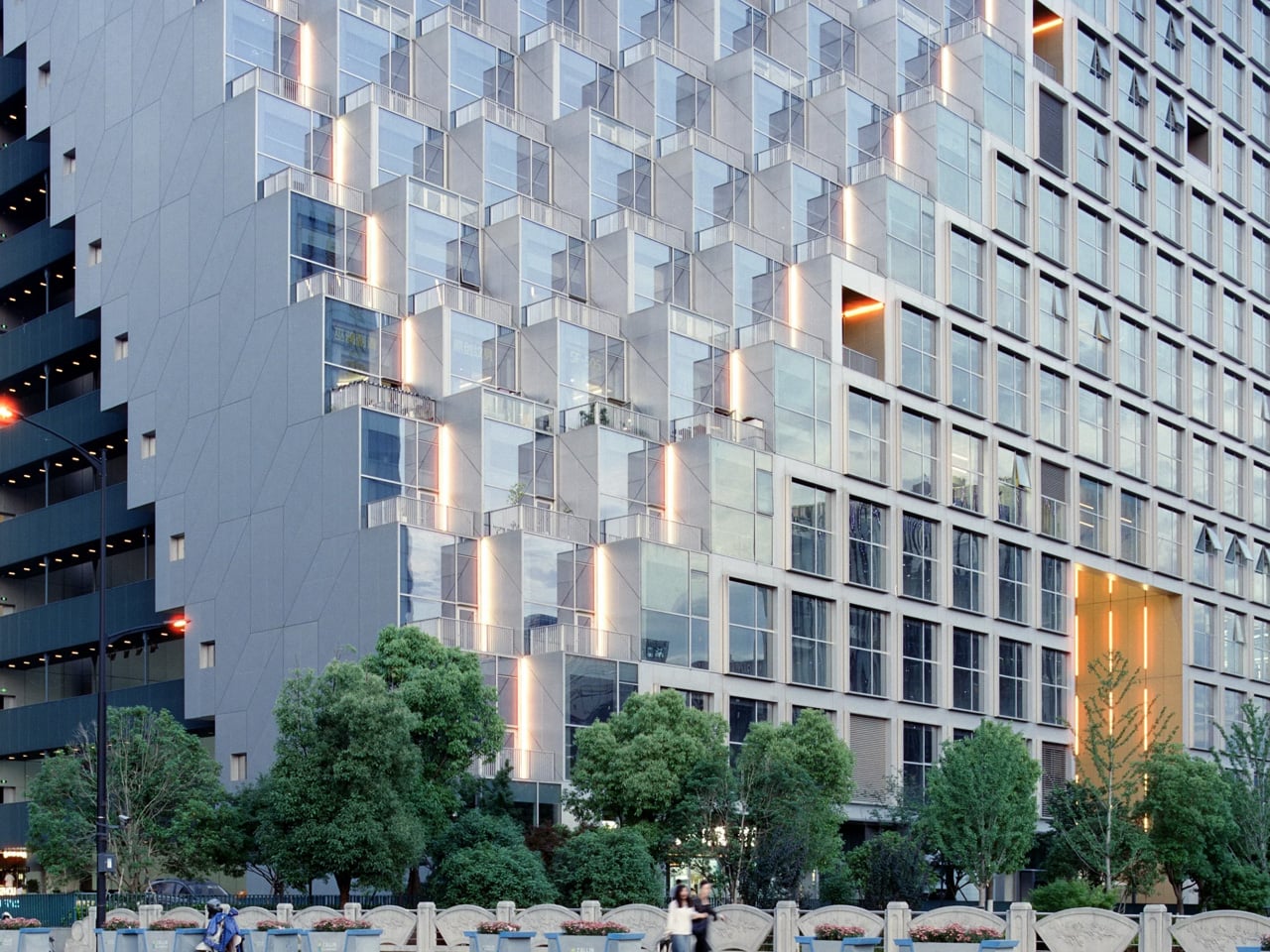
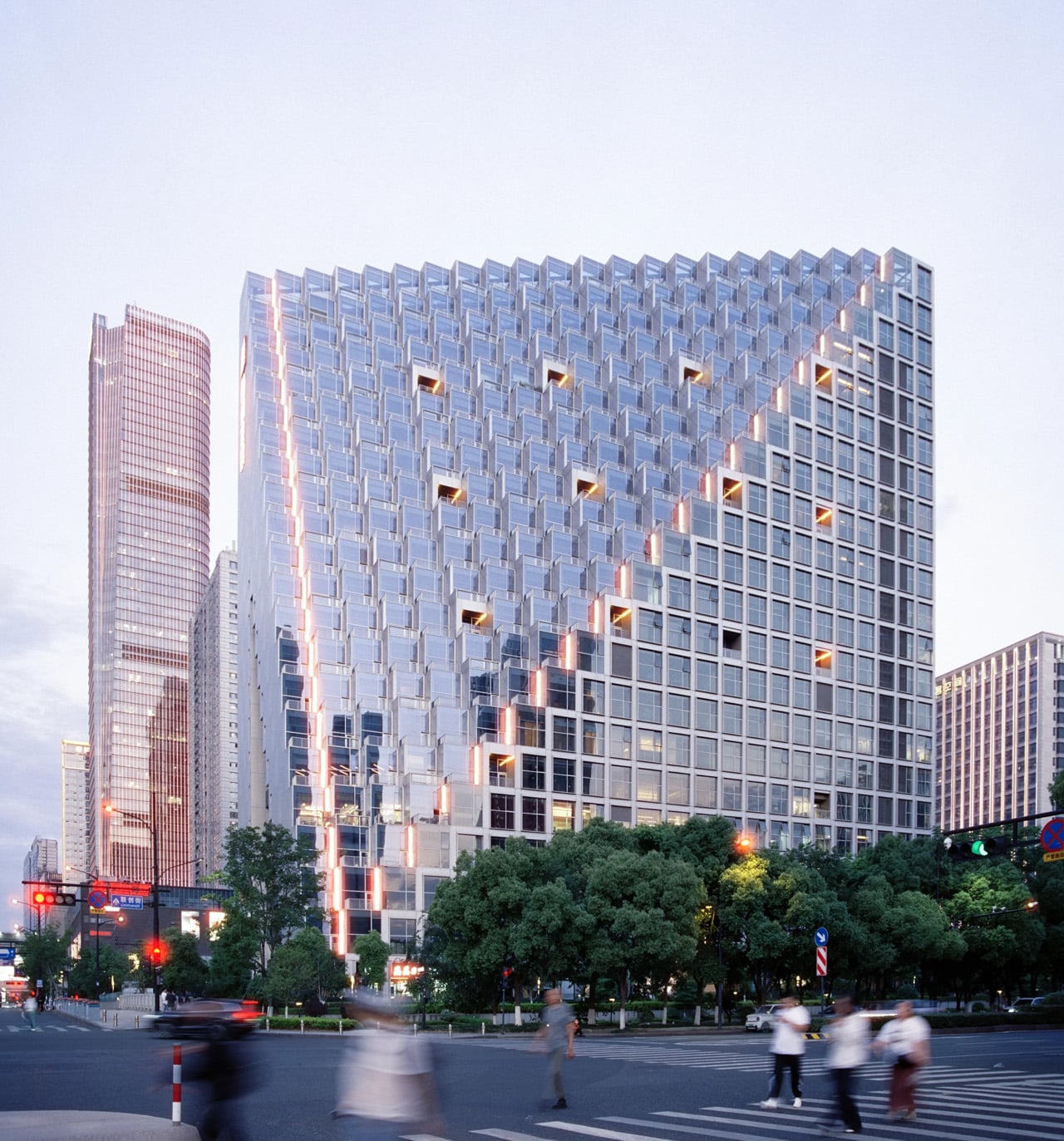
The form is immediately arresting. Two radical oblique cuts slice through the building envelope, giving the Prism its angular, asymmetric silhouette and creating cascading terraced lofts with sweeping views across the city. The projecting cubic balconies that line these oblique facades give the structure texture and depth, so the building reads differently from every angle — less like a static object, more like something mid-transformation.
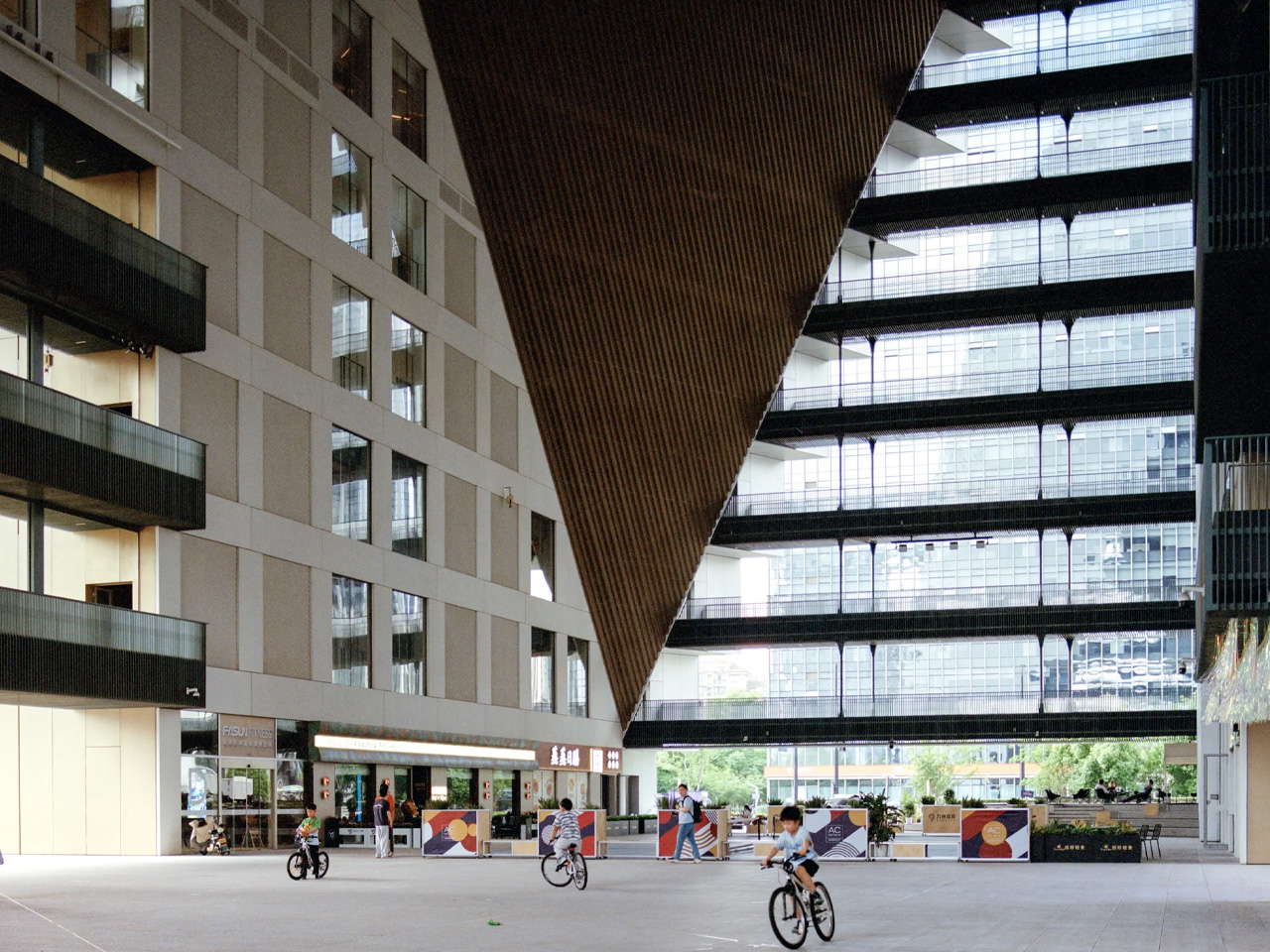
At ground level, the geometry opens up. A large void punctures the flat facades, giving way to a publicly accessible atrium that connects directly to the adjacent park. This base-level square is designed for events, community gatherings, and everyday movement — the kind of activated ground plane that high-rises in China rarely prioritize. It’s a meaningful gesture in a building that could have easily turned inward.
Programmatically, the Prism holds a remarkable amount within its singular form: a 20,000-square-metre hotel, 10,000 square metres of residential units, 5,000 square metres of office space, and 8,000 square metres of retail. The brief is dense, but the architecture handles it without feeling overcrowded. The mixed-use stacking is intuitive, each program finding its natural vertical position within the building’s tapered volume.
Future Tech City is home to companies like Alibaba and NetEase, and Hangzhou is actively positioning itself as one of Asia’s most important innovation corridors. The Prism lands squarely in that ambition — a building that signals civic intent as much as commercial function. Van Duijn put it plainly: “The design of the Prism shares this ambition to innovate.” For OMA, it’s another sharp proof that bold formal moves and genuine public utility don’t have to be in conflict. The Prism earns its skyline position.
The post The Hangzhou Prism by OMA Is the Mixed-Use Landmark China’s Tech Capital Deserves first appeared on Yanko Design.
from Yanko Design



0 Comments